


Shadow Stops and Silent Deals: Structural Flaws in Massachusetts Police Reform
Episode Overview: The Officer Shuffle
This episode breaks down Chapter 5, “Officer Shuffle,” which explores the history and modern reality of police accountability in Massachusetts. It examines the pre-2020 landscape where officers could easily move between departments to avoid a disciplinary paper trail, the creation of the Peace Officer Standards and Training (POST) Commission, and a deep-dive case study of former trooper Khalil Mafoum to show how soft institutional language can mask serious misconduct.
Key Takeaways & Episode Highlights
The Pre-2020 Landscape: Prior to landmark reform, Massachusetts was one of the few states without a mandatory centralized licensing board for police officers, allowing the “officer shuffle” to thrive.
The POST Commission: Enacted under Chapter 253 of the Acts of 2020, this commission was designed to establish centralized oversight and a system of mandatory certification.
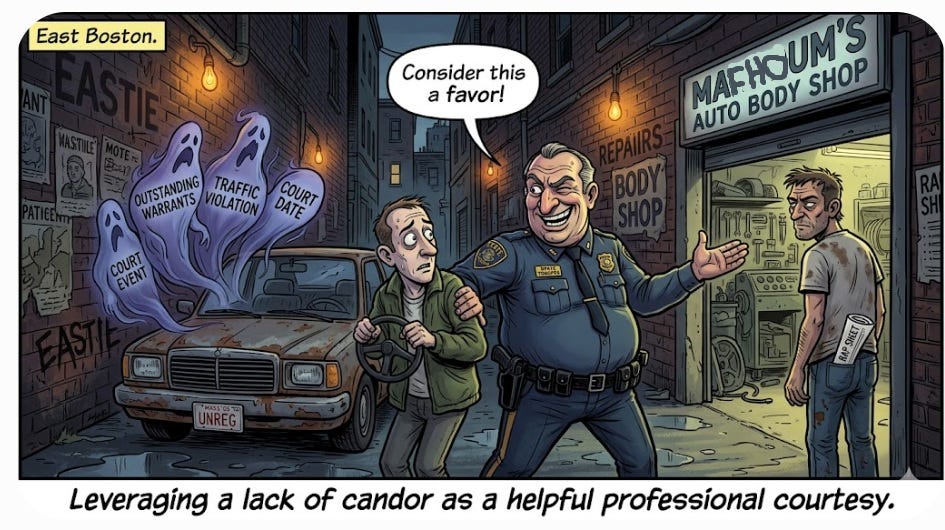
The Case of Khalil Mafhoum: An investigative look into a 2018 personnel file revealing an under-the-table agreement following a cruiser collision, a failure to run standard queries, and an attempt to pressure a civilian into dropping the matter.
Sanitizing Misconduct: How agencies frequently use benign phrases like “unsatisfactory performance” or “conduct unbecoming” rather than explicitly citing a “lack of candor” or systemic dishonesty.
The Secondary Harbor: How the “shuffle” persists today, sometimes utilizing county correctional facilities as alternative employment avenues when a career with state or municipal police stalls.
Book Group Discussion Topics
The Power of Language: The episode highlights how institutions use “gray terms” (like unsatisfactory performance) to describe deliberate subversions of the law. How does sanitizing language affect public trust and systemic reform? Can true accountability exist when the official record is softened?
The “Shadow Stop”: Discuss the implications of an officer failing to run standard system queries during an incident. How does the creation of a “digital footprint” alter the dynamics of roadside interactions and officer liability?
The Limits of Oversight: Despite the creation of the POST Commission, the “officer shuffle” remains a reality because oversight boards rely entirely on the sanitized paperwork they are provided. How can a centralized system effectively audit a culture where silence and under-the-table agreements are used as currency?
Systemic Loopholes: The chapter concludes by noting that correctional facilities can sometimes function as a “secondary harbor” for officers with fractured disciplinary histories. What structural changes are needed to ensure oversight spans across all branches of law enforcement and public safety?


