

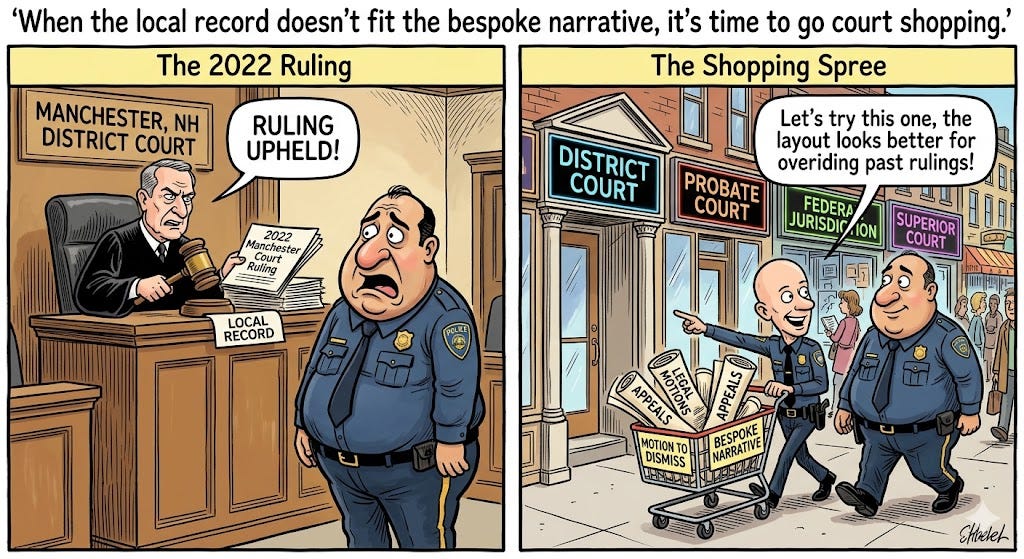
Captain Daniel Unsworth and Officer Khalil Mafhoum Court Shopping in West Roxbury: Bypassing the New Hampshire Superior Court Precedent
In this episode, we unpack Chapter 14 of Watertown: Under Color of Law, titled “Tactical Liability.” This chapter traces the parallel collapse of two carefully managed narratives: an officer’s attempt to manipulate his legal residency across state lines, and a high-ranking commander’s high-stakes bid for a career promotion. We examine how data-driven oversight can shatter a public relations facade and expose the profound vulnerability of an institution that treats transparency as a tactical threat.
Key Themes & Discussion Points
The Sworn Residency Paradox
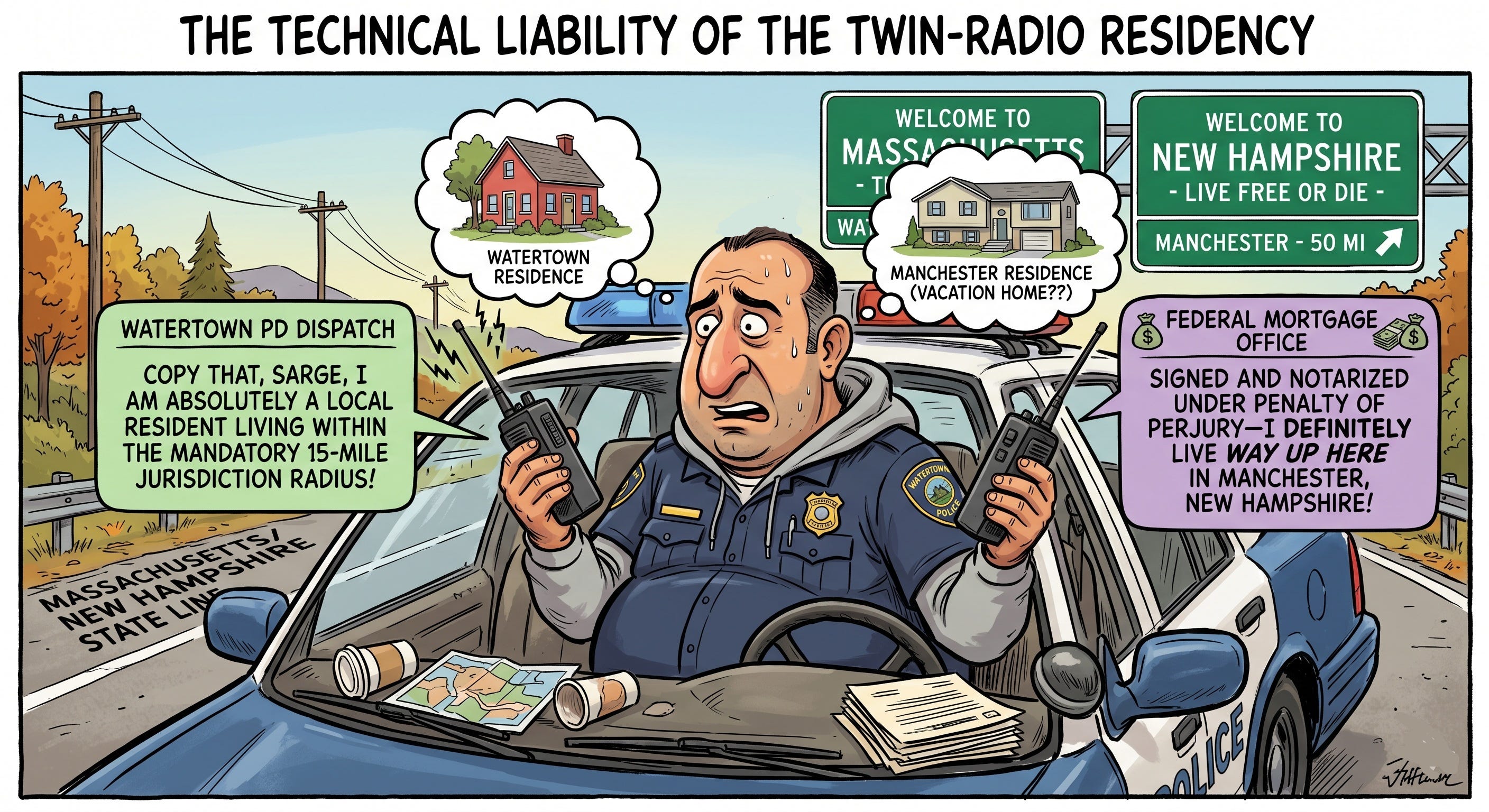
A forensic look at the legal timeline of February 17, 2026, when Officer Khalil Mafhoum executed a remortgage on his New Hampshire residence.
We analyze the profound legal contradiction of an officer signing federal mortgage documents under penalty of perjury declaring his primary domicile is in Manchester, New Hampshire, while simultaneously collecting a municipal paycheck from a department that mandates residency within fifteen miles of its jurisdiction.
The Belmont Rejection
We trace the definitive conclusion of the Belmont Chief of Police selection process on February 26, 2026.
How the Belmont Select Board’s unanimous decision to pass over Captain Danny Unsworth in favor of an out-of-town veteran functioned as a public rejection of Watertown’s insular, defensive command style.
The contrast between Belmont’s rigorous vetting of nineteen candidates and Watertown’s decision to bypass qualified internal veterans for a compromised candidate.
The Potemkin Village of Policy
We explore the historical and literary allusion of the Potemkin Village to describe Watertown’s public-facing commitment to “Kingian Nonviolence” and professional standards.
How the department paints an elaborate, flawless facade of progressive oversight for community consumption, while the underlying personnel decisions are anchored by residency fraud and civil rights liabilities.
The “Warrior” Pivot
The sudden psychological and administrative shift that occurs the moment an institutional leader faces exposure.
How the heavily branded principles of de-escalation and conflict reconciliation were instantly discarded and replaced by an aggressive, traditional “warrior” posture to protect a fracturing reputation.
Quotes Featured in This Episode
“The existence of a sworn federal statement suggests a perspective in which administrative rules are treated as situational variables—enforceable for the purpose of a loan, yet seemingly bypassed for the purpose of a municipal paycheck... Much like the hollow villages of the Dnieper, the department’s ‘commitment to transparency’ serves as a tactical liability rather than a foundational creed.”
Book Club & Discussion Questions
The Dual-State Shell Game: When an individual swears under penalty of perjury to a federal bank that their primary home is in New Hampshire, yet tells a municipality they comply with a local radius mandate, which institution is being defrauded?
The Facade of Reform: How do high-minded training frameworks like Kingian Nonviolence become a “Potemkin Village” when a department’s actual response to public scrutiny is reactionary aggression?
Vetting Accountability: Belmont went out of its way to find a leader with a verified history of high professional standards, while Watertown command facilitated a hire with a forced resignation for covering up a crash. What does this divergence tell us about how different municipalities calibrate the scales of justice?
Resource Links & References
Featured Book: Watertown: Under Color of Law by Amy M. Dubé (2026, Red Oak Media).
Verbatim Document Tracking: Registry deeds, federal mortgage numbers, and board timelines can be verified verbatim in the master file “MAY 10 BEST BEST Under Color of Law cloud.docx”.
Related Chapters: Chapter 13 (”Character Assassination”) and Chapter 15 (”Unlicensed Doctors”).


