


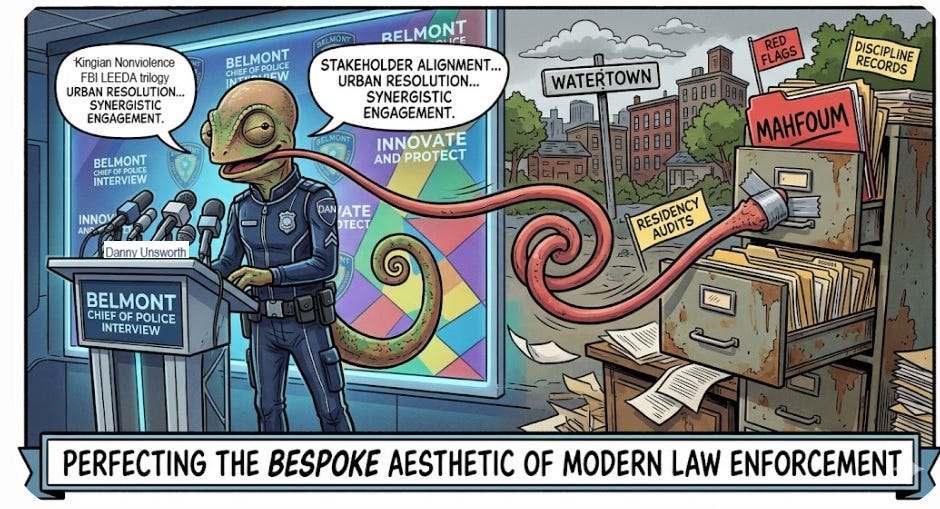
The Potemkin Village of Policy: When Captain Daniel Unsworth’s Image Management Overrides the Bill of Rights
In this episode, we break down Chapter 13 of Watertown: Under Color of Law, titled “Character Assassination.” This chapter exposes the precise moment a municipal bureaucracy abandons subtle containment and unleashes the full, intimidating force of institutional power against a whistleblower. We examine how an administrative “silo” transforms into an aggressive campaign to destroy a citizen’s standing, and how a high-ranking official’s career ambitions collide with an inconvenient public record.
Key Themes & Discussion Points
The Digital Barrage and the Technical Shift
Hours after the whistleblower initiates formal contact with the Watertown Police Department on February 13, the administrative silence breaks.
A persistent influx of anonymous, multi-jurisdictional phone calls floods her line—a digital escalation that signals a sudden shift in the system’s internal temperature.
The Vetting Paradox and the “Summit” Selection
We analyze the high-stakes professional backdrop of Captain Danny Unsworth. In February 2026, while acting as the primary supervisor protecting a controversial recruit, Unsworth is named a top-three finalist for the Chief of Police position in the neighboring town of Belmont.
The striking contrast of a rigorous, consultant-led screening center evaluating a commander for leadership competence at the exact moment a veteran educator, using simple public research, uncovers massive residency and disciplinary red flags that his own vetting process bypassed.
The Fox and the Lion: Machiavellian Pivots
We explore how the department shifts from the strategy of the Fox (using corporate buzzwords, “bespoke” branding, and procedural siloing to quietly trap and dilute the disclosure) to the strategy of the Lion.
When the cunning machinery of containment fails to bury the public record, the apparatus abandons its defensive posture and utilizes raw, institutional force to target the individual who brought those failures to light.
The Ritual of the Scapegoat
An examination of how a City Council and a police department attempt a collective cleansing of their own administrative errors by casting out the messenger.
By weaponizing scrutiny against the whistleblower’s motives and character, the system attempts a high-stakes sleight of hand to distract from a glaring reality: a single teacher with a highlighter successfully audited the most sophisticated vetting tools in the Commonwealth.
Quotes Featured in This Episode
“When the administrative ‘silo’ failed to silence the disclosure, the institutional response underwent a visible shift... The defensive posture was abandoned in favor of an assertive, predatory strategy. The focus was redirected away from the ethical prerequisites of the recruit and the failure of the vetting process, and turned instead toward the individual who brought those failures to light.”
Book Club & Discussion Questions
The Ambition Blindspot: Captain Unsworth was actively pursuing a high-profile promotion to Chief of Police while managing the fallout of a hand-picked recruit’s record. How does personal professional ambition distort an official’s duty to reconcile an accurate public record?
The Machiavellian Shift: Why do powerful institutions reflexively transition from passive, bureaucratic stalling (the Fox) to active character assassination (the Lion) when faced with undeniable documentation?
The Scapegoat Defense: In modern municipal governance, why is it easier for an administration to pathologize a citizen’s motives than it is to admit a systemic failure in their own background checking infrastructure?
Resource Links & References
Featured Book: Watertown: Under Color of Law by Amy M. Dubé (2026, Red Oak Media).
Verbatim Narrative Source: Detailed text dockets and command profiles can be verified directly in the master file “MAY 10 BEST BEST Under Color of Law cloud.docx”.
Related Chapters: Chapter 12 (”Enemy of the Town”) and Chapter 14 (”Tactical Liability”).


