
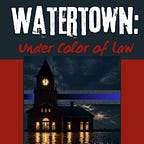

In this episode, we dive into Chapter 10 of Watertown: Under Color of Law, titled “Image Preservation.”
This chapter acts as the emotional and investigative catalyst of the book, tracking the exact moment a private citizen’s path intersected with a public safety cover-up.
We trace how a single social media post shattered a carefully curated facade, revealing a history of profound biographical discrepancies, makeshift structural fixes, and a systematic effort to silence dissent.
Key Themes & Discussion Points
The Recognition
In 2024, a veteran middle school teacher with nearly three decades of public service recognized a face on a polished municipal digital press release: Officer Khalil Mafhoum.
The glowing introduction stood in stark, clinical contrast to a private history spanning from early 2016 through early 2019.
The Architecture of Contradiction
We look at the memory of a 2016 meeting in Watertown, where a purported $30,000 investment in a mechanics shop perfectly overlapped with a legal marriage entered into exactly six months into their dating relationship—the moment Ramadan ended.
How this “investment” immediately materialized as a new home oil tank, a new vehicle for a relative, and international travel.
The academic scaffolding: How the teacher created the foundational flashcards and study aids required for him to pass exams at the New Braintree Academy, and even typed and laminated basic MGL “cheat sheets” for his cruiser.
The Behavioral Pattern of Superficial Fixes
We analyze how an individual’s domestic problem-solving mirrors their administrative maneuvering.
The two telling examples: securing a hamster cage with intricate wire loops that prevented basic daily maintenance, and routing exposed copper tubing along kitchen baseboards to an outdoor porch to power an icemaker, causing the lines to freeze in winter and overtax the refrigerator in summer.
Both highlight a hyper-focus on the superficial appearance of a solution, completely divorced from functional reality.
Seating-Chart Logistics
A look back at the 2018 State Police Academy graduation, where the teacher was explicitly directed to sit alone, completely separated from his family.
A strategic necessity designed to ensure that the disparate chapters of his life—the “official” and the “private”—never occupied the same visual field.
The Ethical Framework of a Citizen
Why a state-licensed professional rejected the common shield of “not my monkeys, not my circus”. Driven by civic duty, she assumed the department was simply unaware of his sustained MSP internal affairs records regarding a failure to report a crash and illegal search and seizure violations.
The naive optimism of February 13, 2026: reaching out to the Watertown Police Department with a helpful dossier, only to be met with total, deafening administrative silence and institutional hostility.
Quotes Featured in This Episode
“Some within the institutions might attempt to minimize his 2018 forced resignation... framing it as a distant mistake by a new officer, or ‘just a cruiser crash.’ Yet, the POST Commission records and internal investigation reports tell a far more precise story. These documents were not about a dented bumper; they were about judgment, legality, and honesty.”
Book Club & Discussion Questions
The Compounding Pattern: How do everyday domestic examples—like the wire-looped hamster cage or the frozen porch water lines—provide insight into how a high-conflict personality attempts to resolve complex administrative and legal problems?
The Weaponization of Shame: When a whistleblower presents independent, sustained internal affairs documents, why is the institution’s reflexive response to attack the messenger as “obsessed” or a “bitter ex” rather than auditing the paperwork?
The Silent Treatment: On February 13, 2026, the whistleblower delivered verified public records to the WPD. Why does a public institution view a citizen providing accurate public records as a threat to be managed rather than information to be acted upon?
Resource Links & References
Featured Book: Watertown: Under Color of Law by Amy M. Dubé (2026, Red Oak Media).
Related Chapters: Chapter 9 (”Discrepancies”) and Chapter 11 (”Administrative Fragility”).


