

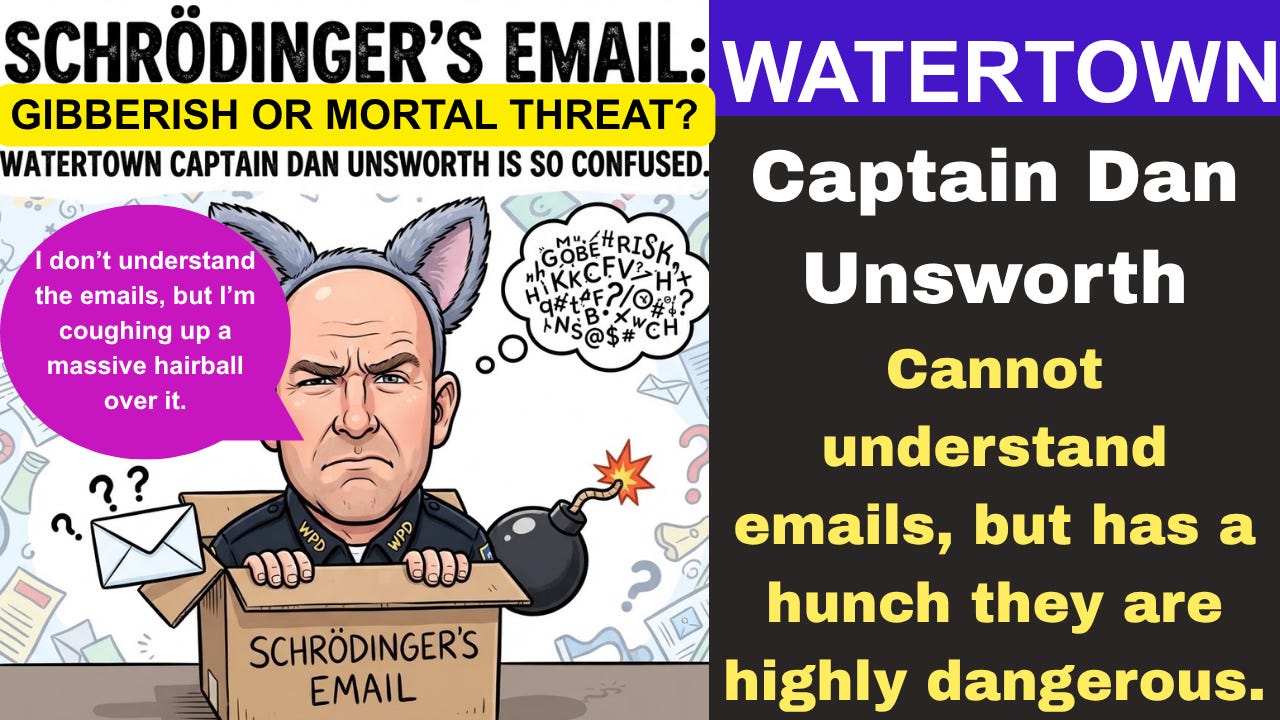
There is a unique brand of bureaucratic theater that unfolds when public officials are confronted with inconvenient paper trails. You watch them squirm, squint at printed pages, and attempt a rhetorical magic trick: transforming straightforward public records into dark, menacing hieroglyphics that somehow threaten their entire way of life—while simultaneously insisting that nobody in the building can possibly make head or tail of them.
Nowhere is this paradox better captured than in the court transcript from the March 13, 2026, hearing in West Roxbury District Court (West Roxbury, MA Courthouse BMC Docket 2606RO00082) before Judge John Garner. When Watertown Police Captain Dan Unsworth took the witness stand, he embodied institutional cognitive dissonance.
Let’s look at how the machinery of oversight reacts when the files don’t fit the narrative.
Exhibit A: The “Threat” That Nobody Can Read
During the hearing, Captain Unsworth was called upon to detail the flood of emails sent by a civilian whistleblower to municipal leaders, city councilors, the city manager, the Secretary of State, Homeland Security, and media outlets.
What were these terrifying missives about? Were they bomb threats? Physical menaces? Not quite. As Captain Unsworth candidly admitted under questioning, there were “not threats to his physical well-being”. Instead, the alleged “threat” was entirely economic—an officer’s fear that his professional history might catch up with him.
But here is where the testimony pivots into surreal comedy. Captain Unsworth described emails containing formal administrative complaints, such as an email detailing:
“conspiracy to circumvent prior judicial rulings, strategic litigation warfare”
and addendums flagging:
“a pattern of lack of candor regarding the petitioner’s residency and conflicting birth years”
When confronted with these precise, documented public records, how did Dan Unsworth, Captain of the Watertown Police Department, respond? He threw up his hands:
“There’s content here I don’t even understand, Your Honor.”
“Some of it just goes on and on.”
“There’s emails that refer to members of Watertown PD ‘shadow tracking.’ None of us know what that means.”
“I’m not sure I can make sense of all the emails, Your Honor, to be honest with you.”
The Great Contradiction: Dangerous Yet Unintelligible
Think about the logical trap being laid here.
On one hand, police leadership attempts to weaponize the legal system by arguing that these communications are so profoundly dangerous, aggressive, and destabilizing that they constitute actionable harassment against an officer’s livelihood.
On the other hand, when asked to explain what the emails actually say, the narrative collapses into helpless bewilderment: We don’t understand it! It’s too long! Nobody at the station knows what ‘shadow tracking’ or ‘residency fraud’ means!
It is the classic embodiment of the old rhetorical truth: It is funny how people suddenly find something utterly confusing and incomprehensible when it acts as an undeniable threat to their unaccountability.
When a public official is handed certified Registry of Deeds documents showing a multi-state residency contradiction, or a Massachusetts State Police Internal Affairs report sustaining a firing for “Lack of Candor”, the easiest defense mechanism in the world is to blink blankly, claim the language is an impenetrable “word salad,” and declare oneself baffled.
Protecting the Livelihood vs. Protecting the Public Trust
As Attorney Bradle pointed out during cross-examination, expressing fear of getting caught, fear of getting sued, or fear of professional embarrassment when exposed for past disciplinary actions does not equal a criminal threat.
You can threaten to report someone to their boss.
You can petition the government regarding public records.
You can point out that an officer sworn under oath in a Massachusetts court also swore primary residency in New Hampshire nine days prior.
These are not encrypted codes.
They are public facts. They only look like confusing, dangerous gibberish if you have a vested institutional interest in pretending accountability doesn’t exist.
When the dust settled, the court recognized these filings for what they truly were: constitutionally protected petitioning activity rather than harassment. No matter how loudly command staff claim they cannot read the handwriting on the wall—or understand the emails in their inbox—the paper trail speaks for itself.
For weeks, the Watertown Police Department’s Chief Justin Hanrahan, Captain Dan Unsworth, and Officer Khalil Mafhoum had utilized the machinery of the courts to construct an elaborate firewall around a compromised personnel file.
But when exposed to the cold, unyielding light of judicial scrutiny, that firewall collapsed entirely.
On March 18, 2026, Boston Municipal Court Judge John Garner formally terminated the harassment prevention order forthwith. In his ruling, the judge made the legal boundary crystal clear:
Fear of economic loss, reputational embarrassment, or the potential loss of employment does not qualify as harassment under Massachusetts General Laws Chapter 258E.
The statute explicitly requires a well-founded, reasonable fear of physical harm or physical damage to property.
Communicating with government officials, submitting public records requests, and exposing a public official’s residency discrepancies constitute core, constitutionally protected speech under the First Amendment.
A restraining order cannot be used as a legal delete button for a public servant’s paper trail.
But before the order was mercifully vacated, the department’s desperation manifested in a reckless escalation directed straight at a public school.
Captain Danny Unsworth weaponized his administrative position by placing an early-morning phone call to the whistleblower’s school district Human Resources division.
By intimating that an arrest could be imminent for an alleged violation of the temporary order, Unsworth manufactured a false security emergency.
This bad-faith intervention triggered an immediate 90-minute hold-in-place (lockdown) across school hallways, placing a veteran educator under a professional Sword of Damocles.
The criminal charges engineered by Unsworth cited a single alleged violation on March 1, 2026—an email sent to the City Council, with copies forwarded to the general WPD inbox and the West Roxbury Magistrate, detailing Mafhoum’s ongoing multi-state residency fraud and the improper West Roxbury venue-shopping.
When the criminal summons arrived, it listed “1 violation” on March 1, yet the actual charging documents were completely void of any specific factual basis explaining how petitioning the government violated a civil order.
Even when cross-examined in court on March 13 by defense counsel Timothy J. Bradl, Unsworth floundered on the stand, utterly unable to articulate what specific criminal act had occurred.
Adding a final touch of administrative sloppiness, the official summons featured a clerical error incorrectly listing the whistleblower’s date of birth as December 17 instead of her actual date.
While orchestrating this campaign of silence and intimidation, Captain Unsworth was juggling a high-stakes career pivot of his own.
In February 2026, Unsworth was actively campaigning as one of three finalists for the prestigious position of Chief of Police in neighboring Belmont.
As Head of Administrative Services in Watertown, Unsworth was the direct recipient of forwarded emails sent by the whistleblower to government officials, meant for objective review.
Instead of initiating a legitimate internal inquiry into residency fraud or checking the “lack of candor” disciplinary history, Unsworth chose a path of institutional cover-up, using his on-duty hours to wage a personal war against public oversight.
Belmont saw Dan Unsworth’s true colors and unanimously voted against his candidacy and in favor of Shane C. Smith.
Echoes of Donahue v. Watertown: A Replayed Playbook
The institutional playbook deployed against the whistleblower is not original; it is a direct, carbon-copy revival of the tactics that cost Watertown taxpayers over $5.5 million in the landmark Detective Kathleen Donahue v. Town of Watertown litigation.
Detective Kathleen Donahue—Watertown’s first female detective—blew the whistle on dangerous weapon discipline during the 2013 Boston Marathon bombing manhunt and a pervasive, toxic culture of sexual harassment within the department.
When Donahue spoke truth to power, the department’s leadership responded by isolating her, spreading rumors, and officially declaring her “mentally unfit” to serve—the modern equivalent of the archaic “hysteria” diagnosis.
The WPD is running the exact same psychological gaslighting playbook today against a whistleblower who exposed a disgraced former state trooper. By attempting to pathologize a meticulous public records audit as a “mental health issue,” Watertown’s leadership proved they learned absolutely nothing from the multi-million-dollar Donahue verdict.
The Irony of FBI-LEEDA and Leadership Optics
The hypocrisy of the current administration is stark when contrasted with its public relations posture.
The Watertown Police Department routinely hosts expensive, high-minded FBI-LEEDA seminars focusing on “Ethics,” “Leadership,” and “Internal Affairs”—a masterclass in fire safety taught by a department of active arsonists.
Chief Justin Hanrahan—a lawyer-chief who balances administrative duties with outside consulting side hustles and book sales—presides over a department that treats transparency as an existential threat rather than a baseline civic duty.
The events of February and March of 2026 exposed the Watertown Police Department operating in a state of terminal denial.
When public officials treat the Constitution as an inconvenience and the courts as a tool for personal reputation laundering, they endanger the very community they swore an oath to protect.
As Judge Garner confirmed when he terminated the order, the truth cannot be locked down, and the public record remains entirely indifferent to institutional panic.